


Photo | XPRIZE Competition
I XPRIZE Competition: Exploring the gap between lifespan and healthy lifespan
Over the past 100 years, global life expectancy has more than doubled, but the quality of health during aging has not improved synchronously. In the United States, there is a 12-year gap between current life expectancy and healthy lifespan (the stage of life without major chronic diseases or disabilities)1.
Over the past 100 years, global life expectancy has more than doubled, but the quality of health during aging has not improved synchronously. In the United States, there is a 12-year gap between current life expectancy and healthy lifespan (the stage of life without major chronic diseases or disabilities)1.
In November 2023, the Saudi Royal Hevolution Foundation sponsored an XPRIZE healthy lifespan competition with a total prize of $101 million for 7 years, aiming to inspire global teams to develop and test therapies that improve healthy aging, and restore at least 10 years (target 20 years) of muscle, cognitive and immune function in people aged 50-80 within 1 year. This event, known as the "Anti-Aging Olympics", attracted more than 600 teams from 58 countries to participate, and it can be called the pinnacle of global anti-aging technology.
2 Milestone 1 Winning Team: Top 40 Global Innovation Forces Breakthrough
On May 12, 2025, the results of the first stage of the XPRIZE Anti-Aging Competition were announced. The top 40 teams from the world's 600 participating teams stood out and each received a prize of 250,000 US dollars for subsequent research. It is worth noting that the registration for the event is still open, and subsequent registered teams can participate in the semi-finals with the top 100 teams. The event will announce the results of the semi-finals in July 2026, and announce the 10 final teams, each with a prize of 10 million US dollars. These teams need to test the therapy for adults aged 50-80 for up to 1 year between 2026 and 2029, and the grand prize winner will be announced in 2030, with a maximum prize of 81 million US dollars.
Urolithin A and circadian rhythm regulation mechanism are among the top 40
The solutions submitted by the participating teams mainly cover the following categories: biological therapy, drugs and small molecules, lifestyle intervention, medical devices, nutritional supplements and functional foods. Many teams tend to adopt integrated personalized strategies, such as combining dietary intervention with new/generic drugs or even cell therapy. These solutions involve a wide range of biological systems from metabolism, inflammation to stem cells, with both universal health effects and specific targets for mitochondrial or neuronal growth, showing the diversity of the competition's exploration direction. Among them, the anti-aging mechanism of regulating circadian rhythm and the nutrient urolithin A have both been successfully shortlisted in the top 40 [see the picture at the end of the article for the complete list of shortlisted candidates].
Figure: Canva
III Urolithin A: Anti-aging dual engines from mitochondrial autophagy to circadian rhythm
1. Activate mitochondrial autophagy to directly hit the "energy crisis" of aging
As the "energy factory" of cells, the functional decline of mitochondria is the core sign of aging. Urolithin A has been confirmed by multiple reports in top journals such as Nature Medicine2 and Nature Aging3 to be an effective "mitochondrial autophagy activator" - it is like a "precision cleaner" in cells, mainly reversing aging through the following mechanisms:
Identification of damaged mitochondria: promotes activation of the PINK1-Parkin pathway and marks dysfunctional mitochondria;
Autophagosome encapsulation and clearance: upregulates LC3-II protein, accelerates autophagosome formation and degradation of old mitochondria;
Mitochondrial regeneration: activates PGC-1α and promotes new mitochondrial biosynthesis.
This high-quality study by Nature Medicine compared the effects of a series of currently popular anti-aging ingredients on extending the lifespan of C. elegans. The data showed that Urolithin A can extend the lifespan of C. elegans by more than 45% on average, and there is a significant dose-response effect; it is significantly better than rapamycin, metformin, NR, etc. in the same group of comparative experiments2.
2. Regulating circadian rhythm: When "biological clock" becomes a new target for anti-aging
(1) The vicious cycle of circadian rhythm disorder and aging: Aging directly leads to a decrease in the expression amplitude of the SCN (suprachiasmatic nucleus) clock gene BMAL1, an imbalance in the rhythm of melatonin secretion, and then causes:
Metabolic disorders: decreased insulin sensitivity, accelerated insulin resistance, and visceral fat accumulation;
Uncontrolled inflammation: enhanced activation of Th17 cells, increased IL-17A levels, and aggravated inflammation induce autoimmune diseases;
Cell senescence: p16INK4a senescent cells in organs such as the liver, brain, and skin further accumulate, accelerating tissue degeneration.
(2) Urolithin A's "dual-axis regulation" of circadian rhythms
Combining the research of Tokyo Institute of Technology in Japan and the China Astronaut Research and Training Center, we found that the unique mechanism of urolithin A on circadian rhythms lies in its bidirectional regulation through "intestinal-systemic":
Intestinal barrier rhythm repair: Urolithin A can reverse the rhythm disorder of clock genes and tight junction proteins induced by inflammation by regulating the expression rhythm of core clock genes in intestinal epithelial cells. In animal models, urolithin A not only restored the normal expression rhythm of tight junction proteins (Clnd1, Clnd4) and clock genes (BMAL1, PER2) in mouse colon tissue, but also effectively regulated the central clock system of the suprachiasmatic nucleus (SCN) of the hypothalamus4.
Rhythm reprogramming of senescent cells: In the TIG-3 cell model of aging and proliferation, urolithin A can significantly enhance the oscillation amplitude of luciferase driven by the BMAL1 promoter. The amplitude of senescent cells increased by about 4 times, and it was dose-dependent5, suggesting that it has a deep repair effect on the rhythmic function of senescent cells.
3. Enhance the endogenous synthesis capacity of NAD and promote cellular energy metabolism
In addition to the regulation of mitochondria and circadian rhythms, urolithin A can also significantly increase the level of cellular NAD+ and promote cellular energy metabolism. Cellular NAD+ level is also an important biomarker of aging.
Effectively increase NAD+: In animal experiments, after supplementing urolithin A, the NAD+ level in mice increased significantly by 50%, and its enhancement effect was equivalent to a 5-fold dose of NR6.
Enhance endogenous synthesis of NAD+: The special thing is that the enhancement of NAD+ by urolithin A is different from direct exogenous precursor supplementation. Instead, it activates the SIRT1-NAMPT pathway to enhance the endogenous synthesis capacity of NAD+ from the source6. This mechanism of enhancing natural metabolism may be more conducive to long-term anti-aging strategies.
4. Safety endorsement: verification from food chain to clinical safety
In addition to its unique mechanism of action on mitochondria, circadian rhythm and NAD+ energy metabolism, the safety of urolithin A is also an important factor in helping it break through the top 40.
Natural metabolites: As a metabolite of intestinal flora of pomegranate ellagic acid, urolithin A has long existed in the human dietary metabolism chain, and the natural amount consumed daily through nuts and berries is about 10-50mg;
Clinical safety data: The US FDA listed it as a "GRAS" (generally recognized as safe) substance in 2018, and multiple clinical trials have shown that it has no abnormal liver and kidney function at a dose of up to 1000mg/day.
Figure: Canva
IV Urolithin A starts empirical clinical research on sleep and anti-aging
1. Latest clinical study of Urolithin A: Decoding the interactive mechanism of aging and sleep
Recently, Bangshang Health submitted a human clinical trial of Urolithin A to improve sleep quality on the Clinical Trial official website, with the US clinical registration number #NCT06990256.
Following the completion of the first oral beauty clinical trial of Urolithin A in the first half of 2025, the second clinical study on Urolithin A to improve sleep quality has also passed the ethical review and entered the implementation stage.
This randomized controlled study is expected to include 80 subjects aged 45-70 years, using a four-blind design (subjects, medical staff, researchers, and evaluators are all blinded), setting up Urolithin A group, fisetin group, combined group and starch placebo group, and conducting a 12-week intervention. It not only focuses on modern health issues such as fragmented sleep and circadian rhythm disorders, but also aims to systematically verify the full-spectrum value of urolithin A in the field of sleep and anti-aging through multi-dimensional biomarker monitoring.
2. Clinical core research design:
Inclusion criteria: subclinical population with impaired sleep quality but not pathological diagnosis (PSQI score > 5 points), excluding caffeine/alcohol addicts to ensure the purity of the intervention effect.
Subjective indicators: sleep quality score, day and night type questionnaire (morning type/night type tendency), daytime dysfunction scale;
Objective indicators: continuous monitoring of body actigraphy, polysomnography analysis;
Biomarkers: NAD+ level, DNA methylation age, inflammatory factors (plasma interleukin), cortisol level, rhythmic protein, insulin resistance index, immunoglobulin level, etc.
"We not only focus on sleep duration and fragmentation, but also hope to reveal the causal relationship between sleep disorders and the aging process through indicators such as epigenetic clocks and metabolic homeostasis." The head of the clinical project said, "The design of the combined use of urolithin A and fisetin aims to explore the synergistic effect of "circadian rhythm regulation + senescent cell clearance", which may provide new solutions for complex scenarios such as menopausal sleep disorders."
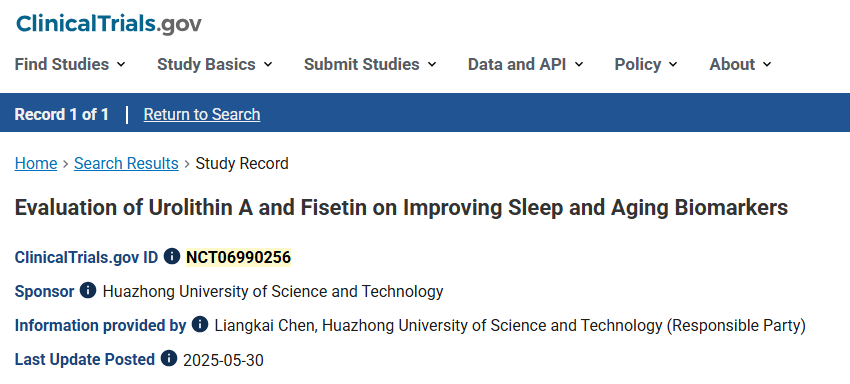
Figure: ClinicalTrials
In the XPRIZE competition, the synergistic entry of urolithin A and circadian rhythm mechanism may give us some new inspiration. Anti-aging is like repairing an old engine, and replacing parts and calibrating the clock may be an indispensable part. When "anti-aging" shifts from consumerist narratives to scientific rationality, Bangshang Health uses urolithin A as a fulcrum to leverage not only the market value of a single ingredient, but also the entire industry's return to "evidence-based". From molecular mechanisms to clinical endpoints, future anti-aging solutions must be systematic solutions with clear mechanisms, clear data, and precise scenarios.
References:
[1] $101M XPRIZE HEALTHSPAN AWARDS FIRST MILESTONE WINNERS DRIVING TOWARD REVOLUTIONARY HEALTHY AGING ADVANCES. News provided by
[2] Dongryeol Ryu, Laurent Mouchiroud et al. Urolithin A induces mitophagy and prolongs lifespan in C. elegans and increases muscle function in rodents. Nat Med. 2016 Aug; 22(8): 879-88.
[3] Mukul Girotra, Yi-Hsuan Chiang, et al. Induction of mitochondrial recycling reverts age-associated decline of the hematopoietic and immune systems. Nat Aging. 2023 Sep;3(9):1057-1066.
[4] Yao Du, Xinyue Chen et al. Effect of Urolithin A on the Improvement of Circadian Rhythm Dysregulation in Intestinal Barrier Induced by Inflammation. Nutrients 2024, 16, 2263.
[5] Rassul Kuatov, Jiro Takano et al. Urolithin A Modulates PER2 Degradation via SIRT1 andEnhances the Amplitude of Circadian Clocks in HumanSenescent Cells. Nutrients 2025, 17, 20.
[6] Ghosh Nandini, et al. Urolithin A augments angiogenic pathways in skeletal muscle by bolstering NAD+ and SIRT1. Sci Rep. 2020 Nov 19; 10(1): 20184.
Appendix: List of top 40 winners of XPRIZE Healthy Lifespan Competition (quoted from Time Pie’s pictures and text)
[1] $101M XPRIZE HEALTHSPAN AWARDS FIRST MILESTONE WINNERS DRIVING TOWARD REVOLUTIONARY HEALTHY AGING ADVANCES. News provided by
[2] Dongryeol Ryu, Laurent Mouchiroud et al. Urolithin A induces mitophagy and prolongs lifespan in C. elegans and increases muscle function in rodents. Nat Med. 2016 Aug; 22(8): 879-88.
[3] Mukul Girotra, Yi-Hsuan Chiang, et al. Induction of mitochondrial recycling reverts age-associated decline of the hematopoietic and immune systems. Nat Aging. 2023 Sep;3(9):1057-1066.
[4] Yao Du, Xinyue Chen et al. Effect of Urolithin A on the Improvement of Circadian Rhythm Dysregulation in Intestinal Barrier Induced by Inflammation. Nutrients 2024, 16, 2263.
[5] Rassul Kuatov, Jiro Takano et al. Urolithin A Modulates PER2 Degradation via SIRT1 andEnhances the Amplitude of Circadian Clocks in HumanSenescent Cells. Nutrients 2025, 17, 20.
[6] Ghosh Nandini, et al. Urolithin A augments angiogenic pathways in skeletal muscle by bolstering NAD+ and SIRT1. Sci Rep. 2020 Nov 19; 10(1): 20184.
Appendix: List of top 40 winners of XPRIZE Healthy Lifespan Competition (quoted from Time Pie’s pictures and text)
Picture: Time Pie


