Most finished formulas rarely rely on a single active. A carb-management capsule, a sleep gummy, or a longevity sachet usually combines two to four ingredients, each covering a different part of the story. That makes pairing logic one of the first decisions in formulation development — long before dosage and flavor work begins.
Below are eight pairing directions built around the ingredients our two manufacturing teams will showcase at SupplySide Global 2026. Each one is a starting point for discussion, not a finished formula.
How We Approach Ingredient Selection
Four filters usually shape the shortlist:
1. Mechanism fit — do the ingredients act on complementary pathways, or simply repeat the same one?
2. Dose and standardization feasibility — a standardized marker (DNJ, crocin, glucoraphanin) only matters if it fits the serving size.
3. Bioavailability and delivery — some actives need enzyme activation, encapsulation, or a solubility strategy to perform at label dose.
4. Regulatory and supply readiness — Self-GRAS status, NDI filings, certification coverage, and stock availability decide whether a concept can realistically launch.
Botanical Extract Pairings — Qingyunshan Pharmaceutical
Smart Carb Control: mulberry leaf as the anchor
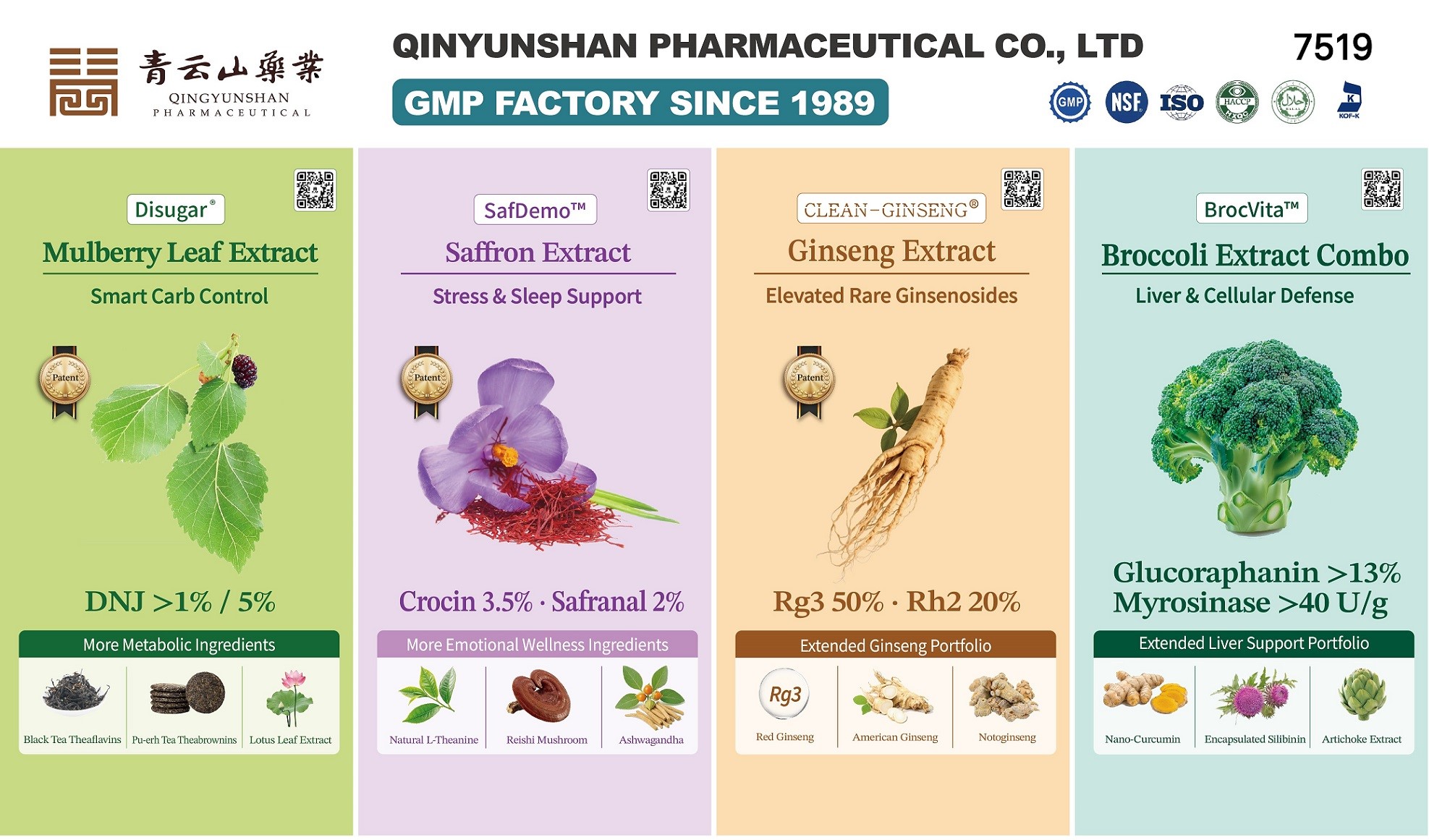
Disugar® Mulberry Leaf Extract (DNJ >1% / 5%) is typically used as the base of a carb-management formula. Black tea theaflavins and pu-erh tea theabrownins extend the positioning toward lipid handling, while lotus leaf extract adds a familiar botanical label story. The practical advantage of this group: all four are water-extract botanicals that sit comfortably in capsules, tablets, and stick packs.
Disugar® Mulberry Leaf Extract (DNJ >1% / 5%) is typically used as the base of a carb-management formula. Black tea theaflavins and pu-erh tea theabrownins extend the positioning toward lipid handling, while lotus leaf extract adds a familiar botanical label story. The practical advantage of this group: all four are water-extract botanicals that sit comfortably in capsules, tablets, and stick packs.
Mood and sleep: one base, two use occasions
SafDemo™ Saffron Extract (Crocin 3.5%, Safranal 2%) works as the standardized core. Pair it with L-theanine for a daytime "calm focus" concept, or shift to reishi and ashwagandha for a PM formula. Because crocin and safranal are quantified, batch-to-batch color and potency stay consistent when the formula is scaled.
SafDemo™ Saffron Extract (Crocin 3.5%, Safranal 2%) works as the standardized core. Pair it with L-theanine for a daytime "calm focus" concept, or shift to reishi and ashwagandha for a PM formula. Because crocin and safranal are quantified, batch-to-batch color and potency stay consistent when the formula is scaled.
Rare ginsenosides: high-value, low-dose actives
CLEAN-GINSENG® Ginseng Extract (Rg3 50%, Rh2 20%) is used where a low inclusion level still needs a strong label claim. Blending with red ginseng, American ginseng, or notoginseng extracts lets formulators tune both cost structure and the traditional-herb narrative — and helps mask the bitterness that concentrates with rare ginsenosides.
CLEAN-GINSENG® Ginseng Extract (Rg3 50%, Rh2 20%) is used where a low inclusion level still needs a strong label claim. Blending with red ginseng, American ginseng, or notoginseng extracts lets formulators tune both cost structure and the traditional-herb narrative — and helps mask the bitterness that concentrates with rare ginsenosides.
Liver and cellular defense: bioavailability first
BrocVita™ Broccoli Extract Combo pairs glucoraphanin (>13%) with myrosinase (>40 U/g) so the conversion step is built into the formula itself. Nano-curcumin and encapsulated silibinin address the same challenge from the delivery side, while artichoke extract supports a digestive positioning. The shared logic across this group is protecting the active until it is absorbed.
BrocVita™ Broccoli Extract Combo pairs glucoraphanin (>13%) with myrosinase (>40 U/g) so the conversion step is built into the formula itself. Nano-curcumin and encapsulated silibinin address the same challenge from the delivery side, while artichoke extract supports a digestive positioning. The shared logic across this group is protecting the active until it is absorbed.
Healthy Longevity Combinations — Herb Green Health
Cellular renewal: three aging pathways in one formula
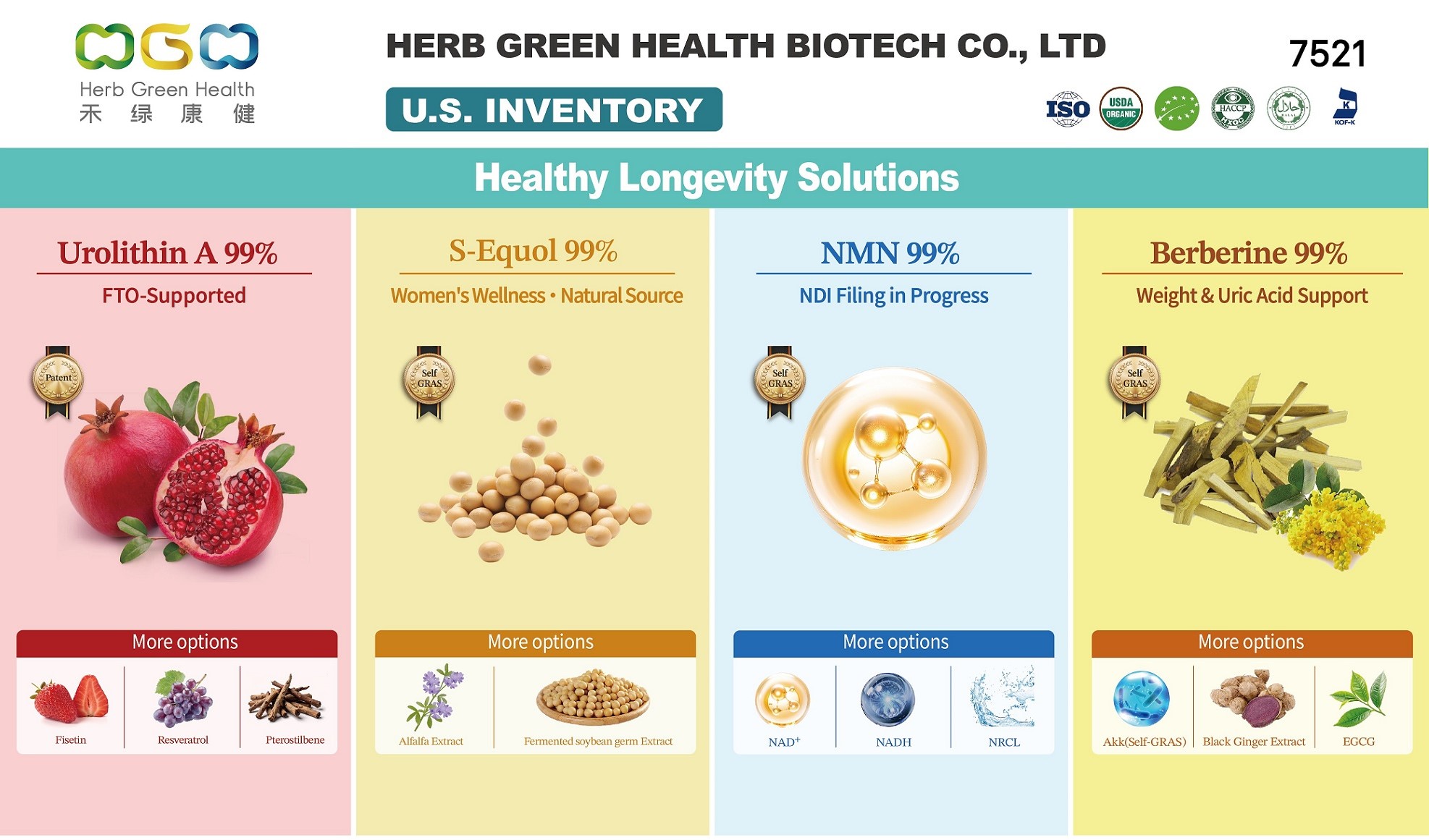
Urolithin A 99% (mitophagy), fisetin (senolytic research), and resveratrol or pterostilbene (antioxidant and sirtuin positioning) are frequently combined because they address different stages of cellular aging. Pterostilbene is often chosen over resveratrol when bioavailability is the priority; resveratrol remains the more recognizable label name.
Urolithin A 99% (mitophagy), fisetin (senolytic research), and resveratrol or pterostilbene (antioxidant and sirtuin positioning) are frequently combined because they address different stages of cellular aging. Pterostilbene is often chosen over resveratrol when bioavailability is the priority; resveratrol remains the more recognizable label name.
Women's wellness: solving the converter problem
Only a portion of the population naturally converts soy isoflavones into equol, which is why S-Equol 99% is used directly instead of relying on conversion. Alfalfa extract and fermented soybean germ extract extend the group toward broader women's nutrition concepts, with Self-GRAS documentation available.
Only a portion of the population naturally converts soy isoflavones into equol, which is why S-Equol 99% is used directly instead of relying on conversion. Alfalfa extract and fermented soybean germ extract extend the group toward broader women's nutrition concepts, with Self-GRAS documentation available.
NAD+ pathway: precursor or metabolite?
NMN 99% is the precursor route; NAD+, NADH, and NRCL give formulators the option to work further along the same pathway. Selection usually depends on target market, claim strategy, and cost per serving — NMN from our range is Self-GRAS certified with NDI filing in progress.
NMN 99% is the precursor route; NAD+, NADH, and NRCL give formulators the option to work further along the same pathway. Selection usually depends on target market, claim strategy, and cost per serving — NMN from our range is Self-GRAS certified with NDI filing in progress.
Metabolic and uric acid support: gut-metabolic axis
Berberine 99% is the anchor, paired with Akkermansia (Akk), black ginger extract, and EGCG. The combination links microbiome support with botanical thermogenic and polyphenol positioning, and both berberine and Akk carry Self-GRAS status.
Berberine 99% is the anchor, paired with Akkermansia (Akk), black ginger extract, and EGCG. The combination links microbiome support with botanical thermogenic and polyphenol positioning, and both berberine and Akk carry Self-GRAS status.
Discuss Your Formula at SupplySide Global 2026 - Pairing decisions are easier with samples, COAs, and a formulation conversation.
October 28–30, 2026 · Mandalay Bay, Las Vegas
Our teams will be at:
Booth 7519— Qingyunshan Pharmaceutical | botanical extracts, GMP manufacturing
Booth 7521 — Herb Green Health Biotech | healthy longevity ingredients, U.S. inventory
Booth 7521 — Herb Green Health Biotech | healthy longevity ingredients, U.S. inventory
Or email us immediately: emma.hsin@taiyi-nb.com.


